Last updated 14 November 2026 · Reviewed by Dr. Lovepreet Singh Verma, founder of Win Your Visa (Punjab Government Licence No. 908)
Short answer: Indian students can study in Serbia at state and private universities, with some bachelor's, master's and PhD programmes taught in English. You first get admission and enrol, then apply for a Type D (study) visa at the Embassy of Serbia in New Delhi, and after arrival you apply for a temporary residence permit. Indian passport holders have needed a visa for Serbia since 1 January 2023.
Study in Serbia for Indian students: quick facts (2026-27)
- Do Indians need a visa for Serbia? Yes. Visa-free entry for Indian passport holders ended on 1 January 2023.
- Which visa do students need? A Type D visa (residence/study) after you are accepted and enrolled, then a temporary residence permit in Serbia. Students renew their residence each year.
- Where do I apply? Embassy of the Republic of Serbia in New Delhi. A decision usually comes within 15 days and can take up to 30 days.
- When are the intakes? State universities usually admit bachelor's students in June and master's/PhD students in September or October. Some private universities also run a February 2027 intake.
- What do I need for a bachelor's? Class 12 completed, recognition of your school certificate by the ENIC/NARIC Centre and, at most universities, an entrance exam.
- What do I need for a master's? A bachelor's degree of 180 or 240 ECTS (3 or 4 years) and, at most universities, an entrance exam.
- Is IELTS compulsory? Not always. Many English-taught programmes accept other proof of English. See study in Serbia without IELTS.
- Can I work while studying? Yes, with a temporary residence permit and a work permit from Serbia's National Employment Service (issued for 3 to 12 months).
- What does it cost? Tuition and living costs vary by university and city. See our cost of studying in Serbia guide.
- What do I do after arrival? Register your address at the police station within 24 hours if you stay in private accommodation.
- Is there an Indian embassy in Serbia? Yes, the Embassy of India is in Belgrade.
Sources: Study in Serbia – Visa and residence permit, Study in Serbia – How to apply, Study in Serbia – Work while studying (checked 14 November 2026).
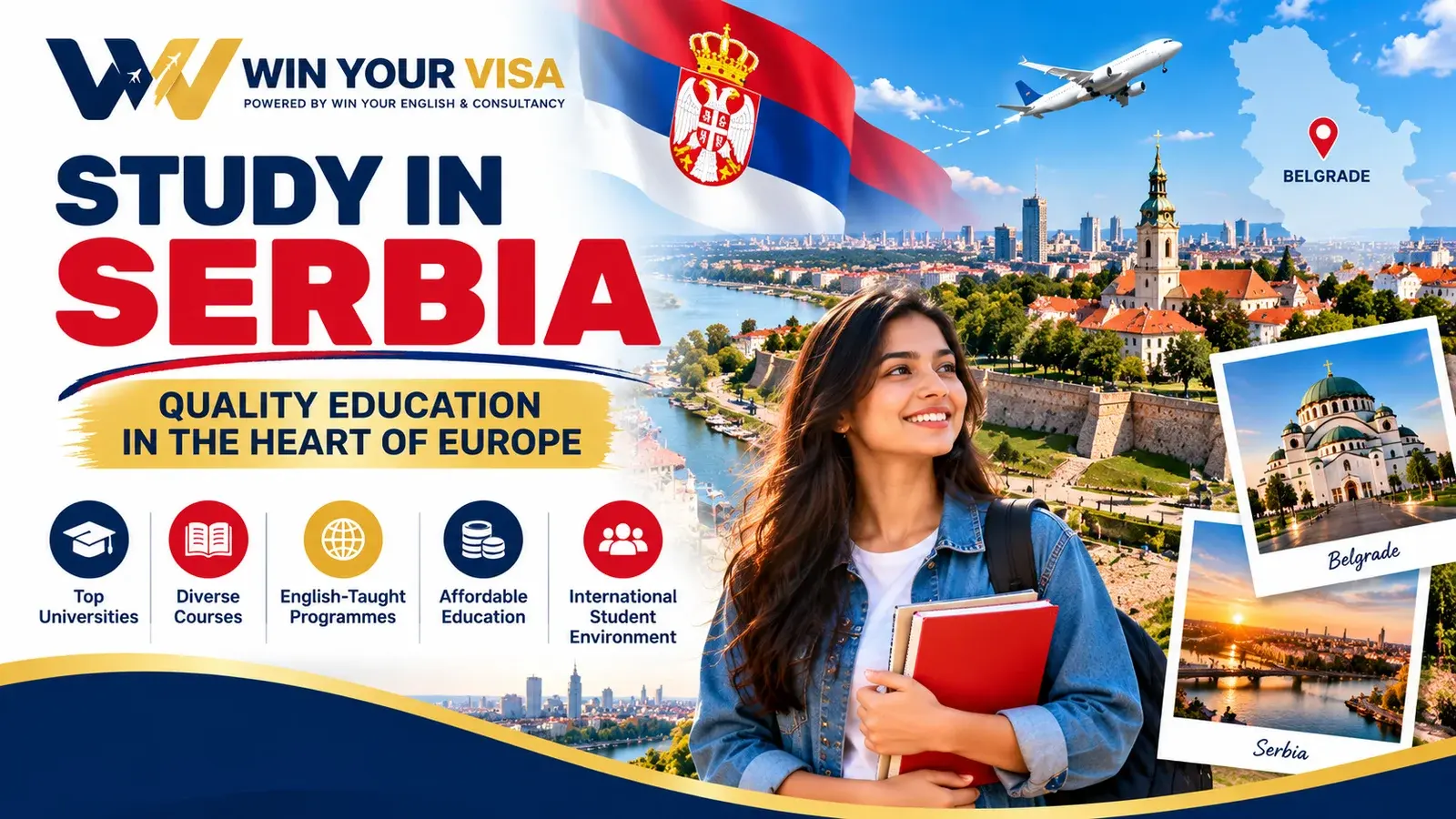
Study in Serbia: A Complete Guide for Indian Students
Are you planning to study abroad from India and explore affordable, internationally oriented higher education opportunities in Europe? Study in Serbia is an option worth researching for students interested in undergraduate, postgraduate and doctoral programmes.
Serbia offers higher education opportunities across fields such as Medicine, Engineering, Information Technology, Business Management, Economics, Tourism, Nursing and other academic disciplines. International students can explore programmes taught entirely or partly in English, depending on the university and course.
At Win Your Visa – Powered by Win Your English & Consultancy, we help students explore study abroad options, assess their academic profiles, identify suitable programmes and understand the admission and student visa application process.
If you are searching for Study in Serbia for Indian Students, this guide explains the universities, courses, eligibility considerations, application process and important factors to check before applying.
Why Study in Serbia?
Choosing a study destination involves more than selecting a university. Students should consider the quality and accreditation of the institution, programme suitability, tuition fees, living expenses, language requirements and future career plans.
Here are some reasons to explore studying in Serbia.
1. Diverse University Programmes
Serbia offers study programmes across multiple academic disciplines, including technology, engineering, medicine, natural sciences, business, economics, social sciences, humanities and arts.
Students can explore bachelor's, master's and PhD programmes through Serbia's official international education resources. The availability of courses, entry requirements and teaching language varies by institution and programme.
2. English-Taught Study Options
Students who want to study in Europe without studying entirely in a new language can explore English-taught programmes in Serbia.
The official Study in Serbia platform provides a database of accredited programmes, including options taught entirely or partly in English. Always confirm the language of instruction for your chosen course before applying.
3. Study Opportunities Across Different Academic Levels
Whether you have completed Class 12, hold a bachelor's degree or want to pursue doctoral research, Serbia has higher education options across different academic levels.
Your eligibility will depend on your previous qualifications, academic performance, selected programme and the university's admission criteria.
4. European Cultural Experience
Serbia offers international students the opportunity to experience European city life, historic architecture, local traditions and a multicultural environment.
Cities such as Belgrade and Novi Sad are worth exploring when comparing universities, accommodation, transport, student facilities and lifestyle preferences.
5. International Academic Opportunities
Some Serbian higher education institutions participate in international exchange and mobility programmes, including Erasmus+ opportunities where applicable.
Participation depends on the university, programme, eligibility rules and specific exchange arrangements. Students should confirm whether their chosen institution and course provide access to relevant opportunities.
Which universities should you explore in Serbia?
When researching universities in Serbia for international students, start by comparing accredited institutions and the programmes they offer.
The following universities and institutions are useful starting points for programme research:
University of Belgrade
The University of Belgrade is a major public university offering study options across a wide range of disciplines. Students can investigate programmes in areas such as engineering, medicine, sciences, economics and social sciences.
University of Novi Sad
The University of Novi Sad offers academic opportunities across multiple disciplines. Students interested in medicine, engineering, information technology, sciences and other fields should review the relevant faculty and programme requirements.
University of Niš
The University of Niš offers study opportunities in several academic fields. Prospective applicants should review the programme language, admission requirements and availability for international students.
University of Kragujevac
The University of Kragujevac provides study options across several disciplines, including academic and professional fields. Students should check the specific faculty and course before deciding whether to apply.
Singidunum University
Singidunum University is a private university in Serbia with programmes in areas including business, information technology, tourism, hospitality and related disciplines.
Students considering Singidunum University should verify the exact programme, degree level, language of instruction, fees and intake availability directly with the university.
Important: This list is a starting point for research, not a ranking. Before applying, check the institution's accreditation, programme recognition, current intake, tuition fees and admission criteria. The availability of English-taught programmes differs between universities and courses.
Which courses are popular in Serbia?
Students researching Study in Serbia for Indian Students can begin by identifying a field that matches their previous education, interests and career goals.
Medicine and Health Sciences
Students interested in medical education can research Medicine, Dental Medicine, Nursing, Pharmacy and related healthcare programmes where available.
For medical and healthcare qualifications, carefully verify the programme's accreditation, clinical training arrangements, degree recognition and professional licensing requirements in the country where you intend to practise.
Do not select a medical programme based only on tuition fees or admission promises.
Information Technology and Engineering
Students interested in technology can explore programmes related to Information Technology, Software Engineering, Data Science, Artificial Intelligence and other engineering disciplines.
Check whether the chosen course is taught in English and whether your academic background satisfies the entry requirements.
Business Management and Economics
Students interested in business can investigate Business Management, Economics, Finance, Accounting, Marketing, Human Resources and related subjects.
The most suitable programme depends on your previous qualifications and long-term career plans.
Tourism and Hospitality
Students interested in travel, tourism and hospitality can research programmes related to tourism management, hospitality operations and associated business disciplines.
Bachelor's, Master's and PhD Programmes
Serbia offers higher education opportunities at undergraduate, postgraduate and doctoral levels. Programme duration, tuition fees, admission requirements and language of instruction depend on the institution and course.
Always obtain the official programme details before making financial or academic commitments.
Who is eligible to study in Serbia from India?
There is no single eligibility rule that applies to every Serbian university or programme. Requirements differ according to the degree level, academic discipline and institution.
Bachelor's Degree
Students applying after Class 12 should check:
- Whether their school qualification is accepted by the university.
- Required subjects and academic marks.
- Whether entrance examinations or additional assessments are required.
- Language requirements and the language of instruction.
- Document translation, certification or recognition requirements.
Master's Degree
Students applying for a master's programme should check:
- Whether their bachelor's degree is relevant to the selected course.
- Minimum academic requirements.
- Required transcripts and degree certificates.
- English-language requirements, if applicable.
- Any additional programme-specific assessment.
PhD Programmes
Doctoral admission may require a relevant master's qualification, research proposal, academic references or other requirements specified by the university.
Applicants should contact the relevant faculty to confirm the complete admission criteria.
Is IELTS Required to Study in Serbia?
IELTS requirements depend on the university and programme.
Some programmes may accept alternative evidence of English proficiency or conduct their own assessment, while others may require a recognised English-language test.
Before applying, ask the university to confirm in writing:
- Whether IELTS is mandatory.
- Whether another English-language test is accepted.
- Whether an interview or university assessment is required.
- Whether previous education in English can be considered.
- What evidence must be submitted with the application.
Do not assume that every Serbian university or English-taught course has a blanket no-IELTS policy.
How do you apply to Study in Serbia?
A well-prepared application begins with programme research and an understanding of the university's requirements.
Step 1: Choose Your Course
Identify the subject and qualification level that match your previous education and career plans.
Step 2: Shortlist Accredited Universities
Check the university's accreditation and confirm that the intended programme is available to international students.
Step 3: Check Eligibility
Review academic requirements, teaching language, English-language evidence, entrance assessments and application deadlines.
Step 4: Prepare Your Documents
The university may request documents such as:
- Valid passport.
- Academic certificates and transcripts.
- English-language evidence, where required.
- Application form and supporting documents.
- Certified translations or qualification recognition documents, where applicable.
- Additional documents specified by the university.
The final checklist must come from the institution and relevant authorities.
Step 5: Submit the University Application
Follow the university's application procedure and pay only the fees confirmed through official documentation or authorised channels.
Step 6: Receive the Admission Decision
If the university accepts your application, carefully review the admission letter, programme details, fee schedule and enrolment instructions.
Step 7: Prepare Your Student Visa Application
After admission, determine the appropriate Serbian visa and residence procedure for your nationality and intended length of stay.
For students who require a visa, the process may involve a long-stay visa for education and subsequent residence formalities. The exact requirements depend on the applicant's circumstances and current Serbian regulations.
Step 8: Prepare for Travel and Enrolment
Arrange accommodation, health insurance, finances and travel only after reviewing the applicable requirements and receiving the necessary approvals.
What are the Serbia student visa requirements?
Admission to a university does not automatically guarantee a student visa or residence permit.
Depending on your circumstances, the authorities may require documents such as:
- Valid passport.
- Completed visa application.
- Admission or enrolment documentation.
- Evidence of sufficient financial means.
- Valid health insurance.
- Accommodation or other supporting documents, where applicable.
- Academic documents and certified translations, where required.
The final checklist depends on nationality, visa category and individual circumstances.
Use the official Serbian government immigration resources and the relevant Serbian embassy or consulate for current requirements. Do not rely solely on an agent's checklist or assume that visa rules are identical for every applicant.
What does it cost to study in Serbia?
The total cost of studying in Serbia depends on your university, course, city, accommodation choice and lifestyle.
Before applying, prepare a complete budget that includes:
- University tuition fees.
- Application and registration charges.
- Accommodation and utilities.
- Food and everyday living costs.
- Local transport.
- Health insurance.
- Visa and residence-related charges.
- Document translation and qualification recognition, where required.
- Airfare and initial settlement expenses.
There is no single fee applicable to all Serbian universities. Request an official fee schedule for your chosen course and calculate your estimated annual expenses before paying any deposit.
Compare universities on total cost, programme quality, accreditation and career relevance rather than choosing solely on the lowest advertised fee.
Can International Students Work While Studying in Serbia?
Students should verify their legal work eligibility before accepting employment in Serbia.
The right to work depends on applicable immigration and employment rules, including the student's residence status and any required work authorisation. Do not assume that every international student can automatically take a part-time job.
When planning your budget, avoid relying on future employment income unless you have verified the applicable rules and have a realistic employment plan.
How does Serbia's university system work? (at a glance)
- Degrees: bachelor's 3–4 years (180–240 ECTS); master's 1–2 years (60–120 ECTS); PhD 3 years; medicine, dentistry and veterinary medicine 6 years (360 ECTS); pharmacy 5 years (300 ECTS).
- Grades: 5 (fail) to 10 (outstanding); 6 is the lowest pass.
- Calendar: September/October to June, with six exam periods (January, February, June, early July, late July, August). Attendance is compulsory.
- English-taught options: on 14 November 2026 the official database listed 224 English-taught programmes for foreign students: 42 bachelor's, 113 master's, 57 doctoral and 12 integrated (including medicine at Belgrade, Novi Sad, Niš and Kragujevac).
- Top universities: Belgrade, Novi Sad, Kragujevac and Niš are all in the CWUR 2026 Global 2000.
- Scholarship: the Government's World in Serbia scholarship is for Non-Aligned Movement countries, including India (call usually closes in early June).
- Recognition: 12th certificates are recognised by Serbia's ENIC-NARIC Centre (usually up to 60 days); degrees by the university.
Step-by-step Serbia guides for Indian students
- Serbia's higher education system explained (degrees, ECTS, grades, calendar)
- English-taught master's programmes in Serbia (113 options by field)
- Study in Serbia without IELTS: who qualifies
- Diploma recognition (ENIC-NARIC): documents and steps
- Serbia study visa (Type D) for Indian students
- Cost of studying in Serbia
- Living in Serbia: police registration, residence permit, health and work
- MBBS in Serbia: eligibility and FMGE
- Top universities in Serbia (Belgrade, Novi Sad, Kragujevac, Niš; CWUR 2026)
- Master's in AI, data science and software engineering
- Entrance exams in Serbia (rounds and ranking)
- Scholarships in Serbia: World in Serbia
- Serbia student visa (Type D) documents checklist
- Is Serbia safe for Indian students?
- MBBS in Serbia in English: course and NMC rules
Why Choose Win Your Visa for Study in Serbia Guidance?
At Win Your Visa – Powered by Win Your English & Consultancy, we help students explore study abroad opportunities and understand the application steps for their selected destination.
Our guidance can include:
- Profile assessment: Reviewing your academic background and intended study level.
- University and course research: Exploring potential programmes based on your profile.
- Eligibility guidance: Identifying requirements that need to be confirmed with the institution.
- Admission support: Helping you organise the application process.
- Documentation guidance: Explaining the documents requested for your application.
- Student visa guidance: Helping you understand the applicable process and supporting documentation.
Every student's profile is different. The appropriate university and programme depend on your academic record, study objectives, budget and the relevant admission criteria.
Our role is to help you understand your options and prepare carefully. University admission and visa decisions remain with the relevant authorities.
Frequently Asked Questions About Study in Serbia
1. Is Serbia a good option for studying abroad?
Serbia may be worth considering for students seeking international higher education opportunities. Evaluate each university's accreditation, programme quality, language of instruction, costs and recognition before deciding.
2. Can Indian students study in Serbia?
Indian students can explore Serbian higher education opportunities, subject to the admission requirements of their chosen institution and the applicable visa and residence procedures.
3. Can I study in Serbia in English?
Yes, Serbia has accredited programmes taught entirely or partly in English. Confirm the teaching language for the exact programme before applying.
4. Can I study in Serbia without IELTS?
Some programmes may offer alternatives to IELTS, but requirements vary. Obtain written confirmation from the university before relying on a no-IELTS option.
5. Which courses are available in Serbia?
Options may include Medicine, Engineering, Information Technology, Business, Economics, Nursing, Tourism, Natural Sciences and other subjects, depending on the institution.
6. How much does it cost to study in Serbia?
Tuition fees and living expenses vary by university, programme, location and lifestyle. Request an official fee schedule and prepare a complete budget before applying.
7. Do I need a student visa to study in Serbia?
Visa requirements depend on nationality and the intended duration and purpose of stay. Applicants should check the current Serbian government guidance and consult the appropriate embassy or consulate.
8. Does studying in Serbia automatically provide access to the Schengen Area?
No. Serbia is not a member of the Schengen Area, and Serbian student status does not automatically grant permission to travel to Schengen countries. Students must meet the entry requirements of each destination.
9. Can I work after completing my studies in Serbia?
Post-study employment and residence options depend on the applicable rules and your individual circumstances. Confirm the current requirements with the relevant Serbian authorities before making long-term plans.
10. How can Win Your Visa help me?
Win Your Visa can help you explore study options, review your profile, understand admission requirements and prepare for the university application and student visa process.
Start Your Study in Serbia Journey
If you are planning to study in Serbia from India, start by choosing the right programme, checking university eligibility and understanding the complete cost and visa requirements.
The right preparation can help you make a more informed decision about your international education journey.
Contact Win Your Visa today to discuss your profile and explore suitable study options in Serbia.
WIN YOUR VISA
Powered by Win Your English & Consultancy
📞 76578-91191 | 93100-00985
📍 Jagraon | Ludhiana
Your Student. Our Guidance. A Global Opportunity.
Disclaimer: University programmes, tuition fees, admission criteria, language requirements, visa procedures and residence rules can change. Confirm all details with the relevant university and official authorities before applying. Admission and visa outcomes are not guaranteed.
Published by Win Your Visa – Powered by Win Your English and Consultancy, Punjab Govt. Licence No. 908 (District Magistrate, Ludhiana), GSTIN 03FOOPS0459J1ZH. Requirements in this guide are checked against official government and university websites on the date shown; always confirm the latest rule before you apply. See our licence.